Line 1-more than 24
Once pine trees sprung from Pelion's vortex
They say that they float through the clear, surging waves of Neptune
Through Phasidos river and the country Aeeteos,
When the chosen youth, the strongest of the adult population,
They choose the golden Colchis turn away skin
When the chosen young man, the strongest of Argive adult population,
Desiring to go away from the Colchis golden fleece
They dared to sail swiftly over salt seas with ships
One the flat, blue salt water with wooden oars
For the goddess who holds the fortresses of the city tops
She made a light wind for the flying chariot
Binding the bent wood into the framework
TheAmphitriten's first rough voyage
she sailed with her beak over the windy sea
and the waves were tortured by the oars and grew white with foam
they looked up from the foaming whirlpool of waves
and the Nereids admired the strange thing
the mortal eyes saw by no other light than the sea
with their eyes the naked nymphs
Then Pelius is said to have caught the fire of love with Thetis
Thetis did not look down upon human marriage
then the father himself knew that pelius must be married to thetis
oh heroes, you were born in the happiest of ages
of your good mothers, hail!
you, i often address you in song
and you are greatly blessed with a lucky marriage (pine) torch
and Oceanus, who circles the world with sea?
now when the awaited day was fulfilled
Lines 60-85
Who away from the weedy, gloomy darling of Minos,
like a marble figure of a bacchanical, look forward, alas
she looks forward and the waves of torment swell
nor does she keep the delicate yellow hair restrained with a headpiece
nor veiling her breast with a cloack
nor concealing her milky- white bosom with a girdle
all of whom slipped off with the turbulence of the sea
before her very feet the salty waves crashed
but neither her headpiece nor flowing cloak
cared not, but on thee, Theseus, with all her thoughts
with all of her spirit, with all of her mind was hanging
miserable, the persistence which grief maddens
joining together the difficult desires
That storm, wild from the occasion that Theseus
setting forth from the wild shores of Piraei
reached the Gortian palace of the lawless king
for they tell of old, driven by a cruel pestilence
to pay a penalty for the slaughter of Androgenoneae
Was to show the chosen youth for the slaughter
Cecropia wanted to give as a feast to the Minotaur
now when his narrow walls are troubled by these problems
Theseus chose to offer himself for his dear Athens
in front of the living corpses so that they could not be taken to Crete
Thursday, February 26, 2009

Wednesday, February 25, 2009
39
Egnatius, who had bright teeth,
Smiles everlasting. If you come to the king
To the courtroom bench, with the speaker exciting on the river,
This shines; if they mourn at the funeral of their son
The mother will weep for the one son,
This shines. Whatever is it, wherever he is,
Whatever he does, he shines: he has death,
Neither elegance, or thinking, nor taste.
So my advice must be given now to you, my good Egnatius.
If you are of the city or you are a Sabine or Tiburnine
Or the pig of the Umbrian or an obese Etruscan
Or a black and tough Lanuvian,
Or Transpadane, or touching my people,
Or anybody, any people who have clean teeth,
You should still not be smiling at all times:
There is nothing more silly than a silly laugh.
Celtiberians are not: Celtiberians are in the earth,
The natives are here, this one time is bad,
And his teeth and gums are red,
For, the cleaner your teeth are,
This is implied when one drinks a lot.
Parsing 5 Verbs:
1. est: 1st person present active indicative of "esse" meaning "to be".
2. esses: 1st person imperfect active subjunctive of "esse" meaning "to be".
3. renidet: 3rd person present active indicative of "renideo" meaning "to shine."
4. praedicet: 1st person present active indicative of "praedico" meaning "to proclaim."
5. habet: 2nd person present active indicative of "habeo" meaning "to have."
Friday, February 20, 2009
Bar Flies
You and your companions of the lustful tavern,
the capped brothers of the ninth pillar,
Do you think that you alone have penises?
Do you think thatyou alone can have sex with whichever girl and call the others he-goats?
Or, because you fools sit in an unbroken line of 100 (or 200 perhaps?)
do you not think that I will dare to rape orally one or two hundred loungers?
Moreover you should think: for I will draw dicks on the front of the whole tavern for you
For my girl, whom has fled my embrace
whom I have loved as no other has loved
for whom great wars were fought by me,
has climbed to those I just mentioned.
all of you fine and well to do men love her, and indeed, which is undeserved, all of the small time louts and alleyway sex maniacs,
you are beyond the longhaired rabbit son of Celtiberae
Egnati, whose dark beard is good and makes teeth scoured in Spanish urine.
Putatis- 2nd person plural present active indicative of the word "putare"; meaning "to think"
Confutuere- 2nd person singular present passive subjunctive of the word "confutuare" meaning "to have sex with"
Fecit- 3rd person singular present active indicative of the word "Facere" meaning "to build"
Est- 3rd person singular present active indicative of the word "esse" meaning "to be"
Consedit- 3rd person singular perfect active indicative from the word "considere" meaning "to sit down"
Catullus' poem 37 cannot be simply categorized as a poem of insult, comedy, or the irony of love and life because it contains all of those elements. Rather, Catullus uses all of those elements to effectively express his dissatisfaction with the "womanizer" attitudes of the young aristocrats that hung out in the tavern. However, did Catullus really write this poem because he was annoyed with the arrogant attitudes of the "barflies"? That is part of it, but two basic human emotions are underlying themes in this poem: insecurity and jealously.
Catullus is not jealous of the "barflies" for their womanizing capabilities. He says "non putatis ausurum me una ducentos irrumare sessores?" which expresses that he is confident that he is more capable than them in getting the ladies. However, sometimes why someone said something is more important than what they said. Catullus writes that to tell the "barflies" that their promiscuous sex lives are no more impressive than the sex life of a he-goat. He uses the devices of comedy and insult to further express his opinion.confutuere et putare ceteros hircos"
Monday, February 2, 2009
catullus 1-40
Once pine trees sprung from Pelion's vortex
They say that they float through the clear, surging waves of Neptune
Through Phasidos river and the country Aeeteos,
When the chosen youth, the strongest of the adult population,
They choose the golden Colchis turn away skin
When the chosen young man, the strongest of Argive adult population,
Desiring to go away from the Colchis golden fleece
They dared to sail swiftly over salt seas with ships
One the flat, blue salt water with wooden oars
For the goddess who holds the fortresses of the city tops
She made a light wind for the flying chariot
Binding the bent wood into the framework
TheAmphitriten's first rough voyage
she sailed with her beak over the windy sea
and the waves were tortured by the oars and grew white with foam
they looked up from the foaming whirlpool of waves
and the Nereids admired the strange thing
the mortal eyes saw by no other light than the sea
with their eyes the naked nymphs
Then Pelius is said to have caught the fire of love with Thetis
Thetis did not look down upon human marriage
then the father himself knew that pelius must be married to thetis
oh heroes, you were born in the happiest of ages
of your good mothers, hail!
you, i often address you in song
and you are greatly blessed with a lucky marriage (pine) torch
and Oceanus, who circles the world with sea?
now when the awaited day was fulfilled
Friday, January 30, 2009
ecphrasis
Sara's mother died when she was born. All of her life she felt guilt about being the reason her mother died and she wished that she had the chance to know her. One day, Sara was in her attic finding the box with the Christmas decorations and she came across a box titled "Jennifer". Time stopped. She was paralyzed in her spot. She didn't know how long she stared at that box, but she decided to open it.
Inside, Sara found a wedding dress and she pulled it out. A tiny picture of a woman on her wedding day fell to the ground. Sara picked it up and recognized the woman as her mother, Jennifer. She closed her eyes and smelled the wedding dress. When she opened her eyes she wasn't in her attic anymore. She saw Jennifer sitting in front of a vanity so Sara called out to her, "Mom!". Jennifer didn't turn. Then the door opened and a woman told Jennifer that it was time for her to go. She got up and followed the woman, Sara followed. Then she saw her grandpa take Jennifer's arm. The organs began playing the familiar bridal tune and the old, wooden doors opened to the church's congregation. She looked down the isle and saw her father and how excited and in love he looked. She decided that she was invisible because no one was answering her calls, so she stood next to her parents as they exchanged vows. Later, at the reception Sara saw how much her parents loved each other and how excited they were to share their lives. Jennifer was so lively, she danced the whole time. Soon the reception was over and her parents were leaving to catch the plane for their honeymoon. As soon as the doors shut, Sara was transported back to her attic at her house.
She was curious to see what else would be in the box. She found a children's book when she looked in. Another picture fell out, it was also of her mother, but this time she was with her family as a little girl.
Tuesday, January 20, 2009
Change
I feel like the inauguration of Barack Obama ushered in a new era of hope for the American people. There were so many people at the inauguration itself (over 1.2 million people), which just proves how many people are excited about the new presidency.
The two references that I found were:
1. The columns of the Capital building were influenced by Classical columns
2. The very word inauguration comes from Latin words such as in- meaning
The two references that I found were:
1. The columns of the Capital building were influenced by Classical columns
2. The very word inauguration comes from Latin words such as in- meaning
Monday, January 19, 2009
Winnie Ille Pu
There are several modern children books that have been translated into Latin.
Here are a few that I wish my parents had gotten for me when I was little...
Here are a few that I wish my parents had gotten for me when I was little...


Thursday, January 15, 2009
part ii
PART II
7. (100 points) for this part, you may use the Latin Library site, but no dictionaries. Answer the following in a five paragraph academic essay: Using the Book of Job from the Vulgate Translation, explain: if God is all-powerful, all-knowing, and all-good, then why do bad things happen to good people? Your answer must cite the Latin text no less than 10 times or you will not receive ANY credit for your answer. You do not have to translate the Latin.
Maybe the reason that God allows bad things to happen to good people is to instill a deeper love of him, an unconditional love. Job mistook the bad things that happened to him as being a punishment from God. Too often in life people do the same thing that Job did. They question God and ask, “Why me?” They immediately think that when bad things happen to them that they are being punished, but when one has nothing to be punished for, and is called by God to be “mea servo” then why is he punished?
It seems a bit contradictory that humans admit to God being “omnipotens”, yet they still question his actions. If they really believed that he knew all then why would they even attempt to understand his mysterious ways? God became angry with Job when he questioned Him, saying, “uis est iste qui celat consilium absque scientia ideo insipienter locutus sum et quae ultra modum excederent scientiam meam”.
God’s actions in the story of Job may be a metaphor for life and the after life. God gives Job all of his possessions back twofold after he endured all the suffering. “ Dominus autem benedixit novissimis Iob magis quam principio eius et facta sunt ei quattuordecim milia ovium et sex milia camelorum et mille iuga boum et mille asinae
13 et fuerunt ei septem filii et filiae tres”. The end of the story may be a metaphor for what will happen in Heaven if one is a good follower of God.
God is saying that things that happen in this life are not given on terms of good behavior, they are given through reasons that only God can know and understand.
If God is all powerful, all knowing, and all good then why would a mere human even attempt to try to understand why bad things happen to good people?
midterm
PART I
1. (10 points) Translate the following.
Please write your translation next to or under the poem.
Vivamus mea Lesbia, atque amemus,
rumoresque senum seueriorum
omnes unius aestimemus assis!
soles occidere et redire possunt:
nobis cum semel occidit breuis lux,
nox est perpetua una dormienda.
da mi basia mille, deinde centum,
dein mille altera, dein secunda centum,
deinde usque altera mille, deinde centum.
dein, cum milia multa fecerimus,
conturbabimus illa, ne sciamus,
aut ne quis malus inuidere possit,
cum tantum sciat esse basiorum.
Let us live, My Lesbia,
And let us value all of the rumors of the old senators at one penny!
Give me a thousand kisses, and then a hundred, and then another thousand, and then a second hundred, and then another thousand, and another hundred
Then, after we have made many thousands of kisses
2. (10 points) In a five paragraph academic essay, answer the following question: Some scholars believe that although this poem is addressed to Lesbia, Catullus actually wrote it with the intention of criticizing the publicly espoused mores of the Republican Roman aristocracy. Explain how these scholars get this idea and then argue either in defense of the theory or argue against it. You must cite no less than 2 examples of grammatical or syntactical evidence from the poem to back up your claim.
Catullus was a very passionate writer. He was opinionated, witty, and unafraid to expose his true desires. This poem may have a duel meaning. The first meaning is obviously seen through his expression of his devotion and love to Lesbia. However, the second meaning is his expression of his contempt for the Roman aristocracy.
He writes “atque amemus,/ rumoresque senum seueriorum/omnes unius aestimemus assis!”. He critiques the judgmental and gossipy nature of the old men in the aristocracy. He says that he values their opinion less than how much he would value a penny. Those words vividly describe his dislike of those men.
He later says that “ne sciamus,/ aut ne quis malus inuidere possit,/ cum tantum sciat esse basiorum.” He is openly admitting that he does not care what those men think of him because he thinks that they are petty. It is almost like a slap in the face to the old men. He is disregarding what those men think
3. (10 points) Translate the following.
Please write your translation under the text.
Catullus I.I
Cui dono lepidum novum libellum
arida modo pumice expolitum?
Corneli, tibi: namque tu solebas
meas esse aliquid putare nugas
iam tum, cum ausus es unus Italorum
omne aevum tribus explicare cartis
doctis, Iuppiter, et laboriosis.
quare habe tibi quidquid hoc libelli
qualecumque; quod, patrona virgo
plus uno maneat perenne saeclo.
Who should I give this lovely little book to?
Cornelius,
4. (10 points) Some scholars have argued that Ovid's story of Europa and the Bull is a metaphor for the Augustan Era. Do you agree or disagree? Write your response in a 5 paragraph academic essay.
Ovid’s story of Europa and the Bull can serve more purposes than mere entertainment. He may have written the story as a metaphor for the Augustan Era. It is an arguable theory, but not necessarily true.
The stories that Ovid wrote served purposes, normally teaching the importance of good morals or just for entertainment. Many of his stories were passed down through tradition. Europa and the Bull was a story about open to new ideas and not being combative and to tell the story of how Europe got its name. Europa became friends with the bull, when all the other girls were afraid of it. The Augustan Era was host to the Pax Romana, arguably the most prosperous and peaceful time in the history of the Roman Empire. However, the idea of being peaceful and open was not necessarily a new idea.
One could make the story of Europa and the Bull into a metaphor for the Augustan Era through relating the peaceful beginning and harsh end of Europa to the peaceful beginning and harsh end of the Pax Romana, but does that mean that was the conscious intention of Ovid when he was writing the story? If all of his other stories were simply stories that had simple meanings, then this story is probably no different.
“Some scholars” could argue that all of Ovid’s stories were metaphors for something because metaphors can be made from any situation, time period, or event relatively easily. Therefore, it is a great assumption to say that he was making that metaphor. If all of Ovid’s other stories were metaphors for events in Roman history then it would be more plausible that the story of Europa and the Bull is also a metaphor. However, his other stories were fables meant to be a metaphor for whatever the good moral that the story describes is or they were stories about the gods that were passed down through tradition.
While it is possible that he made the story into that metaphor, it is a stretch to say that was his intention. Scholars are right in saying that Europa and the Bull could be a metaphor for the Augustan period, but they are most likely wrong in saying that it was his purpose to make it into that metaphor.
Wednesday, January 14, 2009
Stay Classy Planet Earth
Since the weather in Northern North America has been record- breakingly cold, I thought that I would blog about the weather forecast coming up tomorrow for Rome.
The high tomorrow is 51 degrees Fahrenheit and the low is 41 degrees Fahrenheit with a 40% chance of precipitation.

The high tomorrow is 51 degrees Fahrenheit and the low is 41 degrees Fahrenheit with a 40% chance of precipitation.

Seacreast Out
I saw this video when I was posting my own Latin class video on YouTube. This video is also fitting because the show "American Idol" premires tonight and last night.
Tuesday, January 13, 2009
42- Job
42
But responding to God, Job said
I know that you are able to know all and nothing can escape your thought
That which is concealed by your intelligence, without knowledge I therefore foolishly speak and the method o f your manner passes beyond my knowledge
You hear and I speak and ask and you reveal me
Your ear, hearing, I hear you now therefore my eyes see you
Therefore, in person, I blame myself and I urge you to change your mind from ashes and embers
But after you speak is God words which from Job said the anger of Eliphaz Themaniten is my passionate love in you and two friends because you are not in the presence of me you are just as my virtuous servant Job
Therefore, You take up 7 bulls and seven rams and march to my servant Job and offer burning sacrifice on behalf of you therefore my servant Job will beg on behalf of you I will accept his face even if you do not charge him with stupidity nor speak namely he is honest to me just as my servant Job
Therefore, Eliphaz Themanites and Baldad and Sophar Naamathites depart and did just as God said and God accepted Job's presence
Likewise God cleared away Job's sins seeing that Job asked for penance that is on behalf of his friends and God gave Job double of all he had.
Therefore he comes to all his brothers and all his sisters and all he was earlier familiar with and seeing that, they consumed the same bread in their house and moved above his head and they comforted and consoled him for all of the bad that God brought upon him and they each gave him a sheep and one golden earring.
Therefore the Lord blessed Job with more than that which he had previously with 40 thousand sheep and 6 thousand camels and a thousand yoke of oxen and a thousand she- donkeys
And with seven sons and three daughters
And he said that the name of the first day and the name of the second Cassia and the name of the third horn antimony
Therefore, they were not finding women more beautiful than Job's daughters in all of the region and their father gave an inheritance among their brothers
Then Job lived for 4 hundred years and his sons and his son's sons for 4 generations and then he died, full of days
Sunday, January 4, 2009
liber iobi; caput I
In the land of Uz there lived a man named Job and he was a simple and righteous fearing God and avoiding evil and born unto him were seven sons and three girls.
And in his possession were seven thousand sheep and three thousands camels
Likewise, 500 yoke of oxen and 500 female asses and a exceedingly large family and this man is greater than any of the men in all the east
And he walked with his sons and they made a feast throughout their home, each one his own day, and his men sent and summoned three of his sisters to put away the banquet and drink when they at any time they went over around the day of the banquet they were sent by Job and sanctified that who they ambushed at dawn he offered burnt scarifices even though he said that his sons were sinnersburned the sacrifice for every sin and they indeed, truly my sons have sinned and they praise God with their hearts thus they make Job (all day) but with the day the sons came God appeared before them
and on that particular day the sons of God were sent to appear before God and with them came Satan
Monday, December 29, 2008
Horace's "monumentum aere perennius"
Discuss how Horace tried to bring Greek poetry forms to the Latin language. Do you agree with his assessment of his accomplishment in Ode 3.30? Cite no less than ten lines / examples from Horace (in Latin ). 8 pages.
Horace is not worthy of the praise that he gives himself in his poem, Ode 3.30. He was not the first poet to bring Greek poetry forms to Latin poetry, Catullus was. Catullus used the Sapphic verse in two of his poems, 11 and 51. Horace wrote more poems of Greek meter. Eighty- eight to be exact throughout his Odes I-III. Sapphic verse basically looks like this: - u - x - u u - u - - - u - x - u u - u - -
- u - x - u u - u - x - u u - -
Horace’s “great” “monumentum aere perennius” was writing his poetry in the Sapphic meter shown above.
Horace was partially accurate in saying that he has created a monument more lasting than bronze and loftier than the royal structures of the pyramids or “Exegi monumentum aere perennius reglalique situ pyramidum altius” simply because his words have stood the test of time, not because his poems featured Greek forms. They are a testimony to human emotions and how people have had the same emotions since the beginning of time. While it is true that Horace’s poems are studied for using Greek verse, is it not the content of a poem that is most important?
Horace’s poems give people a window into Roman life because he wrote about his everyday life. He wrote about the Roman Empire under the Augustan peace. “Tutus bos etenim rura perambulat / butrit rura Ceres almaque Faustitas”(Ode 4.5) He means that the countryside of the empire is flourishing and Ceres and Prosperity nourish the land. However many of his famous poems are about women that he was infatuated with; women that he wanted to have sex with. It is ironic that the poems by Catullus and Horace that feature those themes are censored or banned in schools, but the very students who are banned from those poems are listening to music that expresses the same sentiment. Horace and Catullus are the predecessors to modern musicians such as Dave Matthews, Lil Wayne, and Bare Naked Ladies (just to name a few). Take Dave Matthews’ “Crash into Me” for example.
“Touch your lips just so I know
In your eyes, love, it glows so
I’m bare boned and crazy for you
When you come crash
Into me”
Compare it to Horace’s lyric poetry from his Ode I.v.
“quis multa gracilis te puer in rosa
perfusus liquidis urget odoribus
grato, Pyrrha, sub antro?”
“Which elegant boy, drenched with liquid
perfumes, is kissing you among many roses,
Pyrrha, in a pleasant grotto?”
Both artists write about love and desire, which are basic human emotions. However, Dave gets the girl and Horace is left alone. “qui nunc te fruitur credulus aurea” (1.5).Horace asks her, “Who now enjoys you, credulous, all-gold?” Horace is dismayed because his love has left him for someone else. That is a feeling that most people go through in their lives, and not just in present times. The pain of heartbreak has afflicted people throughout the ages. Divorce rates have been high since the late 1960s. Students (and people in general) today are constantly having sexuality and other “bad” influences thrown in their face by the pop culture media. Yet most schools continue to ignore that teen pregnancy rates are rising; or instead of ignoring it, they give kids condoms and tell them not to use them (see video below). However, Horace talks about his emotions. He talks about how he misses Pyrrha, which is much more realistic than just saying that he should have never even gotten involved with her because sex is “bad”.
Horace does not deserve the praise that he gives himself in his Ode 3.30 for bring Aeolian verse to Italian poetry; he deserves it for the words that he left the world; words such as “carpe diem” (1.11.8) and “dum loquimur, fugerit invida aetas” (1.11.7-8). Horace himself said the he wanted his words to live forever “Non omnis moriar multaque pars mei vitabit Libitinam”(3.30.6). He says that his body may die, but that his soul will forever live in the pages of his poetry. The sentiment expressed in his Ode 1.11 will certainly live forever. “Carpe diem” is a well-known phrase that has inspired people over the ages to live for the day and not to trust that there will be a tomorrow. In the movie, “The Dead Poets’ Society”, it inspires young men from a strict, private boarding school to be passionate about life and to realize what their own desires are instead becoming the doctors and bankers and lawyers that their fathers want them to be. Those ancient words surround us in different forms; such as, the slogan for the American Eagle brand is “Live your life.”
Horace lived his own words. He said “carpe diem” to a girl that he wanted to sleep with because he did not want her to worry about what other people would think of her for being promiscuous. He wanted her to seize the day and to live the moment that they were presently in. Horace’s words have stood the test of time and they continue to be prevalent today. His words are his “mountain of bronze”, not the type of verse that he used.
Monday, December 15, 2008
discussion
1. How long did Sumerian Civilization exist?
ca.5400- 1940 BC
2. How long did Rome exist?
27 BC – AD 476 / 1453
3. Will America exist to a comparable age? Say it does; what will it look like?
I do think that America will exist to a comparable age. I think that it will have more housing to accommodate the growing population. I picture something similar to the new developments that seem to have sprung up over night all over suburban Maryland where all the houses are almost identical.
lit terms
1. allegory: a prolonged metaphor
2. Simile: a comparison of two things using the words like or as
3. litotes: understatement
4. onomatopoeia: making noises into words ex. whoosh, bam
5. caesura: a break or pause in a sentence or line
6. enjambment: the running over of one line into the next
7. apostrophe: the turning away from the audience to talk to someone who is dead, or not present
8. alliteration: using words that begin with the same sound or letter in a sentence
9. epic simile: a simile in which an action or something that has happened is compared to something in nature
10. epigram: a short letter, it originally meant an engraving on a tombstone
11. personification: giving something inanimate human qualities
12. metaphor: associating two things together
13. chiasmus: A B B A
14. elision: two words that run together
15. ellipsis: omission of words that are understood
16. oxymoron: combining two very different words into one phrase ex. "little giants"
17. irony:
18. rhetorical question: a question that is not meant to be answered
19. amoboen: two parties exchanging dialogue with another
20. catalogue: any list
Wednesday, December 10, 2008
Translation Test- Catullus 1-10
Catullus 1
Who should i dedicate my delightful thirsty little book that has a manner as polished as a pumice stone?
Cornelius, you: in fact are in the habit of being able to travel with anybody and believe nonsense
you go then with intent is one and all the tribes of Italy time unfold papyrus to teach, Jupiter, and painstakingly!
Therefore, have you whichever that book at any time; what, o virgin patron, greatly one remain continual age.
3- 1.5
Mourn, o Venus and Cupid,
and how many is of the prettiest people:
the dead parrot is my girl's,
the parrot, delight of my girl,
who she loved more than her own eyes
7
How many of my kisses are you seeking, Lesbia, that they may be more than enough.
How great a number is the sand of Libya
The laserpicium lies in the blazing Cyrene
between the oracle of Jupiter and
Battus' ancient sacred tomb.
Or how many stars, when the night is silent,
They see the hidden love of people
So many kisses ito kiss you
is wild, Catullus
Which neither they may be able to count
Up the spies nor evil is able to bewitch the tongue
10
Varus led me leisurely from the
forum to see his new love:
the whore (she is looking at me so unexpectedly)
not sensibly intelligent nor unattractive;
we were coming so, we fell into different conversations
Napkin thief
Have you no better topics to write about?
why does my liking of napkins offend you so?
You truly honor me, Catullus,
with your interest in my doings
For you are such a great and upstanding man
and I, but a lowly napkin thief.
Out of all of the topics of the world
you chose to write about me,
even though you do it out of hate,
it is flattery nonetheless.
forgive me, Catullus, I did not know
that those napkins were so precious to you.
they are mere cloth, but apparently
they are also food for your short temper.
I am humbled by your attention
to my shortcomings and I pray
for the forgiveness of such an morally upstanding man such as yourself.
Monday, December 8, 2008
"an eye for an eye makes the whole world blind"
I think that it's horrible that an enforcer of the law would ever shoot a child for a minor offense. That's not to say that the boy who was shot is innocent. It was stupid of him to throw rocks at a police car, especially if the policeman was in the car, but he did not deserve to die. I don't think that the public reacted well. The riots are not fixing any problems, they are only creating more animosity. I believe that "an eye for an eye makes the whole world blind" as Ghandi once said. Those citizens of Athens have a right to be angry with their government and they have a right to fight for what they want, but no one has the right to take away another person's life. They are also destroying their own city and after the riots are over they still have to live in the mess that they created.
7- sight reading
With in apparent is his occupation, He waged war with the Romans. This is nothing, they went through Africa (his father was called Mago) they consulted with P. Sulpicium and C. Aurelium. His teachers told him told him to go from Carthage to see Rome, the senate and the people were thankful to see him, because with his presence came peace, from the king his spirit gives simultaneously, he assumed Fregellis
Wednesday, December 3, 2008
How Many Kisses
You ask me how many kisses will satisfy you, Lesbia, may it be more than enough.
How great are the numbers of sand in Libya
The lasarpiciferis lies in the blazing hot Cyprus
between the oracles of Jupiter and the Battius' ancient, sacred tombs;
or how many stars, when the night is quiet,
They see the hidden love of people:
To kiss you and kiss you more
is wild, Catullus, more than satisfying
Which neither they may be able to count
Tuesday, December 2, 2008
Poem
Wonderful Itunes, you hold my music
it is beautiful to my ears
and it soothes my soul
for many years you have helped guide me
in my room and in my car
I listen to that music that you hold
it takes the broken pieces and makes them hold
you have a playlist for my every mood
I love you almost as much as food
today you gave me some Bob Dylan for my journey to school
you make all other music storage devices look like fools
you also give me music while I run
it makes the trip around Bel Air much more fun
some call it noise
I call it art
Mr. Vitucci may take my music from you
but he can never erase it from my heart
anyways i can always re-download it
that's about as hard as eating a banana split
I listen to Brett Dennen on the beach
his music is as refreshing as a peach
You are truly wonderful, dear iTunes
you do your job well
every time I listen to you it raises my morale
I don't know what I would do without you
..maybe use Rhapsody
but you are much better
and defiantly the music storage device for me
Monday, December 1, 2008
Lit Terms- Horace Ode 1.37
Line 1
"Nunc est bibendum, nunc pede libero"- anaphora
Line 17
"remis adurgens"- Synedoche
Line 17
"acciptur velut"- simile
Line 20
"daret ut"
postposition
Lines 22-23
"perire quarens nec muliebriturexpavit ensem, nec latentis"-anaphora
"Nunc est bibendum, nunc pede libero"- anaphora
Line 17
"remis adurgens"- Synedoche
Line 17
"acciptur velut"- simile
Line 20
"daret ut"
postposition
Lines 22-23
"perire quarens nec muliebriturexpavit ensem, nec latentis"-anaphora
Sunday, November 30, 2008
Now Only Lasts For One Second
Define Epicureanism and explain how Horace's poetry fits into the general philosophy. You must cite / close read the Latin of no less than five poems by Horace. 8 pages.
Epicureanism was founded around 307 BC and it is a philosophy based on the beliefs of Epicuris. He was a follower of Democritis. Democritis was an atomic materialist, which means that he believed that all things were made from matter. Therefore, he believed there is no God, gods, or spirits. He did not believe in superstition or divine intervention. Atomic materialism is the antithesis of idealism. Epicureans believe that the way to experience true happiness and achieve the greatest food is to seek modest pleasure which would five them peace of mind and to learn about how the world works and the limits of human desires. They believe in living every moment of their lives to the fullest and they believe in deriving as much pleasure as they possibly can out of each of those moments. They did not believe in thinking about consequences or what the future may bring. Epicureanism is often mistaken for hedonism. They are related, both proclaim that pleasure is the only intrinsic good, but Epicureans believe that being without bodily pain is the greatest pleasure and they support a simple lifestyle. Hedonists are the more materialistically indulgent of the two groups.
Horace was an Epicurean. He makes this evident throughout much of his poetry. Horace’s 1.1 illustrates the Epicurean belief that pleasure is the greatest good a person can have. He begins the poem by thanking Maecenas. Maecenas has, in many ways, enabled Horace to be a poet because Maecenas is his patron. Lyric poetry brings Horace much pleasure, so he dedicated his book of lyric poetry to the man who enables him to write it.
The rest of that poem was about other people finding pleasure in what they do. After the dedicated to Maecenas he writes about Charioteers and their spectators. “Sunt, quos curriclo pulverem Olympicum collegisse iuvat metaque fervidus evitata rotis palmaque nobilis terrarium dominos evehit ad deos.” This means “there are some that delight in racing chariots and avoiding burning wheels at the turning point in the Olympian dust and the noble palm lifts up the lords of the earth to the gods.” He is saying that the charioteers enjoy the glory of the racing and the challenge that the race brings. They have to avoid the spikes that are in the other racers’ wheels. The people watching derive pleasure from watching the racers. It makes them feel distinguished and noble, almost as though they are gods.
Later in the poem (Lines 15-18), Horace illustrates the Epicurean belief that people should be free of pain. He writes of a merchant who came home early with broken rafts because fighting the Africans was bringing him too much pain. He came home in order to get as much pleasure out of his life as possible instead of waiting until he beat the Africans to have pleasure in life.
The last thing that Horace writes about in this poem is his own love of writing poetry. He writes “Me doctarum hederare praemia frontium dis miscent superis, me geldum nemus” which menas “the rewards of being a doctor of ivy, mixes my brow with the higher gods.” He is saying that he revels in the rewards he gets from writing poetry. He feels distinguished just by this simple occupation. He feels as though he is one of the gods. The simplicity of his pleasure is a major belief in the Epicurean philosophy.
Ode 1.5 is about how Horace avoided the pain of heartbreak through pursuing a girl, Pyrrha, who was already involved with another man. He writes that he has saved Pyrrha from “shipwrecking” as in her relationship with the other man was a shipwreck and Horace was truly the right choice. This relates to Epicureanism in that Horace avoided pain through winning Pyrrha, therefore bringing himself pleasure.
Horace’s Ode 1.22 is a love poem to Lalage. He tells her that his love for her is invulnerable. This poem also follows the Epicurean belief in simple pleasures. “Integer vitae scelerisque purus non eget Mauris iaculis neque arcu, nec venetatis gravida sagittis, Fusce, pharetra.” He says that he does not need deadly weapons in order to have a full and pleasurable life. He is not afraid of death. He writes of traveling to different place, but only wanting to be with love, Lalage. Horace finds simple pleasures through laying in an empty field, many people would view this as a waste of time because he is not being productive, but were humans really put on the earth to constantly be productive? No one really knows why humans were put on earth, but Horace chooses to spend the time that he has earth lying in fields, thinking about his love and his poetry.
Ode 1.37 addresses another major Epicurean belief. They do not believe in an afterlife, so there is no need to fear death. Cleopatra did not fear death after her troops failed. “ausa et iacentem viscere regiam voltu sereno, fortis et asperas tractare serpents, ut atrum corpore combiberet venenum”. Cleopatra committed suicide, which was considered an honorable death. She was serene and unafraid of the snakes that bit her. The Latin says that her body drank the serpent’s venom. Also in this ode, Horace writes of how Cleopatra became drunk off of cheap wine after she knew that her troops would lose. In a sense it is in keeping with Epicurean beliefs, but it also differs. It brought pleasure to Cleopatra to become drunk, but it was overindulgence on her part which is against Epicurean beliefs of seeking simple pleasures. She had to change her state of mind in order to receive pleasure out of the situation. Epicureans also do not drink cheap wines. They believe in drinking the best because there may not be a tomorrow so there is no point in saving wine for a special occasion; everyday is a special occasion.
Horace’s Ode 1.11 encapsulates the philosophy of Epicureanism with two words, “carpe diem”, meaning “seize the day”. Of course, in the poem he says, “carpe diem”, in order to persuade Leuconae to have sex with him. The entire line is “Carpe diem, quam minimum crodula poster”, meaning “Seize the day, putting as little trust as possible in tomorrow.” He said it to give her a new perspective on the situation. He did not want her to refuse him because for fear of what others may think. He told her to do what she could do today, because there may not be a tomorrow. He teaches to live every day as though it was the last. “Carpe diem” has become one of the most famous quotes in the world and it can be applied to most people. Horace taught people to look at the world in a different way. Instead of worrying about the future or feeling like they have some debt they have to pay today in order to have pleasure tomorrow he teaches that love and pleasure should be found in everyday occurrences. He teaches that human relationships should always take priority over work or business.
The first thing Horace says in the poem is “tu ne quaesieris (scire nefas), quem mihi, quem tibi finem di diderint, Leuconoe, nec Babylonios temptaris numerous”. That means that Leuconae should not worry about the future for that would be sacrilege because only the gods know what the future hold. Horace is saying that what is meant to be will happen, so it is a waste of time to worry about will happen since it is going to happen anyways.
In order to drive that point home, Horace uses two examples. “Seu pluris hiemes, seu tribuit Iuppiter ultimam, quae nunc oppositis debilitat pumicibus mare Tyrrhenum,” The first example is Jupiter can allow for many more winters or she can allow for the current one to be the last one, either way humans have no effect on it and it is just up to the god’s whims. He says that to Leuconae because he does not want her to fear the god’s wrath. He is basically telling her that the gods could care less about what she does. The second example is one pumice stone damaging the Tyrrhenian Sea, instead of the sea damaging the stone. The stone obviously cannot damage a sea too much. Horace uses that example to illustrate that Leuconae is just one person and there thousands more people the gods worry about. Her actions cannot damage everyone because she is the pumice stone and the rest of the world (including the gods) is the sea.
He also says earlier, “dum loquimur, fugerit invida aetas”, meaning “while we talk, jealous time flees.” He is saying that she should not hesitate or waste time that she could be spending with Horace hesitating. This philosophy has survived through the ages. Hootie and the Blowfish’s “Time” is an example of this. “Time, you left me standing there; Like a tree growing all alone” says that wasting time doing things that are not truly important, such as nurturing relationships with other people or challenging popular (possibly misguided) beliefs will only lead to loneliness. The next lines in the song are “The wind just stripped me bare, stripped me bare; Time, the past has come and gone; The futures far away; Now only lasts for one second, one second.” That supports Horace’s Epicurean belief of living in the moment. The reason Horace told Leuconae that time is fleeting is because he knew that if she thought about the consequences of her actions she would never have sex with him. Horace challenges Leuconae to think for herself, to do what she thinks is right or what she wants to do regardless of what others think.
Horace has given the world a true gift through his words. The philosophy of “carpe diem” has survived the ages and continues to inspire people today. People embrace those words and apply them to their lives. Without those thoughts there may have never been the works of Picasso, Warhol, and da Vinci. Those artists would have been too busy worrying about what other people think to dare to create something original, they would have wasted their time hesitating.
Wednesday, November 26, 2008
Translation Test- Horace Ode 1.37
Now is the time to drink, now is the time for free feet to move
Now is the time for the people of Salii to feast and decorate the sacred couch in the temple of the gods, friend.
Previously it was a crime to make Caesubum wine in the ancestral cellar
While the queen went insane from power
And prepared for the death of her government
The queen was foul and shameful
Her servants were sick and weak men
Drunk with the wine from victory
Cleopatra escaped from the fire with only one ship
The cheap wine from Mareotis made the queen
Frenzied and she feared that Caesar was coming from Actium
Pressing hard upon their oars, just like the soft hawk
The fatal monster, which is with dignity
She does not die like a woman
She is frightened by the sword, but does not try to hide
Even the wise king looked a her judged face
The now peaceful face, it is fierce and strong to behold serpents
Her body drinks the poison entirely
Consider carefully her fierce death:
Surely envious are those on the fierce war ships
Her pride led like a humble woman's triumph
Extra Credit
Horace's dedication was heartfelt and sincere, while Catullus' dedication was making fun of his friend, Cornelius. Horace dedicated his poetry to his patron and friend, Maecenas. Horace praises Maecenas for being noble, Catullus sarcastically talks about Cornelius.
Wednesday, November 12, 2008
Translation Test 1.1 1.5 1.11
Maecenas is descended from royalty
and he has my protection and dear honor
some enjoy meeting at the dust of the Olympic racetracks
wave the noble palm branches
on the sacred land used by the gods.
May you not worry about what the gods give to me, or give to you
nor be intimidated, Leuconoe, of the Babylonians numbers.
over many winters for triburt Jupiter ultimate,
not that the stone has weakened the sea
Tyrrhenum, wisdom,
for jealous time is fleeting
Seize the day, have little trust in the future
Monday, November 10, 2008
1.1 & 1.11 vocab quiz
1. rex, regis: king
2. praesidium: protection
3. curriculum: plan
4. pulviis: chariot
5. dominus: god
6. torrba
7. gaudeo:
8. pavidus
9. mercator: market
10. bratus
11. lituus
12. detestor: detest
13. plaga
14. frons, frontis: front
15. melleror
16. hiems: storm
17. tribuo: triumvirate
18. pumex
19. spatium: spite
20. resceo: rescue
bonus
aetas: life
carpe diem: seize the day
Tuesday, November 4, 2008
Vote or Die
1. Athens, in the 5th century, had a direct democracy. Which is different from the representative democracies of the modern world. However, there were much less people voting because only men who were of Athenian ancestry and they had to be 18 or older. Also, in this time those men had slaves who would do labor for them which allowed for them to go to debates and be involved in politics.
2. There were two types of legislative assemblies in the Roman Republic. There were "comitia" or committees that were assemblies of all citizens and there were "concilia" or councils that were assemblies of specific groups of citizens. Citizens were organized into tribes and centuries and each would gather into their respective assemblies. The "Comitia Centuriata" or Century Committee was the assembly of the centuries. A consul was usually the president of committee. The centuries would vote one at a time until the measures that they were voting on won the majority. They elected magistrates and censors and they were the only ones who could declare war and ratify the results of a census. The century assembly also serves as the highest court of appeal in certain judicial cases. The "Comitia Tributa" or the Tribune Committee was an assembly of Tribes. The Committee was comprised of 35 tribes and a consul presided over them. The tribes were originally created through geographical regions, but that practice ended with sons taking over their father's tribe spot and living in a different region. The tribes also voted one by one. However, the order that they voted in was determined through a lot. After one person voted they would pick the next name out of the lot. They believed that the gods chose the order through the lot, therefore the first person selected was the most important. The Tribes elected three different magistrates: Quaestors, Curule Aediles, and Military Tribunes. They also had the power to try judicial cases. The Plebian Council or "consilium plebis" was the principal popular assembly of the common citizens of the Roman Empire. Plebians were commoners. The Plebian council could pass laws, elect magistrates, and try judicial cases. Plebians could elect two Plebian Magistrates, the Plebian Tribune, and the Plebian Aediles. Usually the Plebian Tribune presided over the assembly, but sometimes the Plebian Aediles did also. The Council eventually gained control over almost all domestic legislation.
3. During the Roman Empire the practice of voting was lost in a sense. The Emperor now controlled everything and had absolute power. Emperors kept the Senate around though because they had experience with governing the empire and experience with war. The Emperor also sent out men who were in government to govern certain regions of the empire as it continued to grow.
4. The U.S. voting practices are mostly closely related to the voting practices of the Roman Republic. The different councils and committees are similar to our electoral college. However, there are some traces of the Ancient Greek's true democracy in that every citizen has one vote.
5. I think that the Ancient Greek way of voting was the best, even though it was only men of a certain age with an Athenian ancestry that could vote. I feel like those men who did vote were truly educated on the issues. They attended the assemblies during which any one could speak and voice their opinions. I think that those assemblies are still present today in America and there are many outlets to which any citizen could receive information about their candidate and outlets to which citizens can voice their opinions. I think it's great that every citizen over the age of 18 can vote in our country and I wish that we didn't need an electoral college. However, many people choose to not educate themselves, therefore their vote may be misguided. I think that the popular vote normally determines who the electoral college votes for, and there have been mistakes, but until the American people educate themselves on the issues, an electoral college is necessary.
http://www.cedarville.edu/academics/education/resource/schools/chca/othergrades/greecetd/greece1.htm#democracy
http://en.wikipedia.org/wiki/Legislative_Assemblies_of_the_Roman_Republic#Voting_procedure_2
http://www.unrv.com/government.php
http://www.archives.gov/federal-register/electoral-college/faq.html#whyelectoralcollege
Wednesday, October 29, 2008
Epicureanism
Epicureanism is a system of philosophy based on the teachings of the atomic materialist, Epicuris. His philosophy condemned superstition and divine intervention. He believed that his philosophy could free people from the fear of death and bad supernatural forces. He theorized that the soul was made of atoms as well as the body which meant that the body would die with the soul. Which means that no one would go to heaven or hell. He believed that happiness is always achievable and that in order to achieve it one must not desire material possessions.
I think that this view of the world is almost pessimistic, but maybe that's just the Christian in me speaking. I disagree with his view that nothing happens when we die and so does my faith. However, I strongly agree with his belief that people would be happier if they did not value materialistic things so much, even though some materialistic things are necessary.
I think that this view of the world is almost pessimistic, but maybe that's just the Christian in me speaking. I disagree with his view that nothing happens when we die and so does my faith. However, I strongly agree with his belief that people would be happier if they did not value materialistic things so much, even though some materialistic things are necessary.
Introduction
Horace's life was over some very important times in the Roman Empire's history. He lived through the civil war between Caesar and Pompey and 48 BCE Caesar defeated Pompey at the battle of Pharsalus. Caesar went on to rule Rome solely until his assassination in 44 BCE. After his death, there was more fighting led by Brutus and Cassius against Antony and Octavian, who were the heirs to Caesar. Horace was a part of the republican forces that were defeated at the battle of Philippi in 42 BCE by Antony and Octavian. Then Antony and Cleopatra were defeated by Octavian at the Battle of Actium in 31 BCE. Both Antony and Cleopatra committed suicide which cemented Octavian's power. During all of this Horace was writing.
Horace's full name is Quintus Horatius Flaccus and he was born on December 8th, 65 BCE in the town of Venusia in Italy. His father was a freedman or ex slave who worked as an auction agent. Horace was brought to Rome for his early education where he received the usual education for a person of the equastrian or senatorial class in Rome. After his primary education he went on to study philosophy at the university in Athens. During his time in the university there was political turmoil following Caesar's assassination. Six months later Brutus came to Athens recruiting men for his army- Horace was one of those men. He was appointed military tribune, which was considered a very high honor for someone who were not headed for the Senate. That position gave him the title of equestrian. Brutus' republican army lost at the Battle of Actium. Horace's lands were given to Octavian's soldiers and he was left without a job. This opened up the door for him to become a poet. He got a job as a clerk for the trustees of the public treasury. He made a decent salary, but more importantly it gave him time to write. Eventually he began sharing his writings and he became friends with another poet, Vergil. Vergil connected Horace with Maecenas, who became a sponsor of Horace. Maecenas also connected Horace with Augustus. Horace died on November 27, 8 BCE.
Horace wrote his poetry over a period of thirty years. His first publication was Book 1 of the "Satires" in 35 BCE and he published Book 2 five years later. Horace followed in Lucilius' footsteps because he believed him to be the founder of the Latin satire. Then he started writing Epodes. He was inspired by the style of Archiliochus of Paros and he modeled his own writings after him, but used his own subject matter such as political and sexual topics. He then wrote 103 poems of the "Odes" in a collection of 4 books. They were lyrics poetry and they were considered to be written in the meter used by Greek poets. His last piece of writing is the "Epistles". They were letters that raised issues of literary or philosophical matters.
Wednesday, October 22, 2008
Live the Words
We have a mug at my house that is from a line of products called "Quoteables". On the mug is a quote from Osho that says, "Life should not only be lived, but celebrated!" I was looking on their website and i found a quote that I'm pretty sure is from Seneca. It says, "Thank you for being." I liked that quote so I looked for some other meaningful quotes from Seneca. This is what I found:
"Difficulties strengthen the mind, as labor does the body."
"As long as you live, keep learning how to live"
"I shall never be ashamed of citing a bad author if the line is good."
"It is not because things are difficult that we do not dare; it is because we do not dare that they are difficult."
"Let tears flow of their own accord: their flowing is not inconsistent with inward peace and harmony."
"It should be our care not so much to live a long life as a satisfactory one."
Monday, October 20, 2008
take home quiz- scanning
--/--/-uu/-uu/-uu/-x
inter/pellan/di locus /hic erat:/ 'est tibi /mater,
--/--/--/-uu/-uu/-x
cogna/ti, quis/ te sal/vo est opus/ haud mihi/ quisquam.
--/-uu/--/--/-uu/-x
omnis/ composu/i:' fel/ices! /nunc ego /resto.
-uu/--/--/-uu/-uu/-x
confice/! namque in/stat fa/tum mihi /triste, Sa/bella.
-uu/-uu/--/-uu/--/-x
quod puer/o ceci/nit di/vina mo/ta anus /urna:
Horace 1-20 Scanning
-- /-- u/u - - / - -/uu/-x
Ibam /forte vi/a sacra /sicut /meus /est mos.
-uu /- u-/ - uu/- -- / -x
Nescio /quid medit /ans nugarum,/ totus in /illis.
--/- -/- -/- uu /--u /-x
Accurr/it quid/am no/tus mihi /nomine /tantum.
--/--u/u--/--/-uu/-x
Arrept/aque ma/nu: "quid ag/is, dulc/issime/ rerum?"
uu-/--/--/--/--/-u-uu-x
'suavit/er, ut/ nunc est/ inquam,/ et cup/io omnia quae vis.'
- - - - -- -- -
Cum adsectaretur: 'numquid vis?' occupo, at ille
--/ - -/- -/- u-/ - -u/ -x
noris /nos in/quit doct/i sumus. /hic ego:/ pluris
--/-uu/--/--/--/--/-x
hoc in/quam mihi /eris. /Miser/e deis/cere /quaerens
-u /uu -/--/ - - /- - /- -/u -/- x
Ire /modo oc/ius, /inter/dum con/sister/e, in /aurem.
--u /-uu/ - -/-u-/--/--x
Dicere/ nescio /quid pu/ero, cum/ sudor/ ad imos.
--/--/- u u /u--/-x
Mina/ret tal/os. o te,/ Bolane, cer/ebri
--/-u-/--/--/-u-/-x
Feli/cem aiebam /tacit/us cum /quidlibet /ille
--/- u-/ -- /- u- /- x
Garri/ret vi/cos ur/bem laud/aret. ut /filli
- -/ - u- /- -/ u u-/ --/--x
Nil res/pondebam/: ' miser/e cupis/ inquit /abire;
-u u-u------
Iam dudem videro. sed nil agis, usque tenebo
-u-/ - u - /-- /- uu /u- -/- -x
Persequar/ hinc, quo nun /citer /est tibi/. Nio op/us est te
--u/--/- uu /--/-- u/u -x
Circuma/gi: quon/dam volo /viser/e non ti/bi notum.
- u-- -- u- - -
Trans Tiberim longe cubat is prope Caesaris hortis
- u u/ - - ---- - - u u - u u - x
‘nil habe/o, quod ag/am, et non/ sum piger:/ usque se/quar te.’
Saturday, October 18, 2008
All You Can Eat

For most people in ancient Rome, grain or corn and oil and wine were staples in their diets. Cereals were also staples and they were made from husked wheat made into porridge. Naked wheat was later made into bread, which was the most often eaten food in ancient Rome. It was sometimes sweetened with honey or cheese and eaten along with sausage, domestic fowl, game, eggs, cheese, fish, or shellfish. Fruits and nuts were also very popular.
Roman Games

Romans played ball games in an field that was previously used as a drill ground for soldiers that was by the Tiber River. It was very popular. Even Caesar and Augustus exercised there, however women were not allowed to participate. They played games such as handball, soccer, field hockey, catch, and dodgeball.
Saturday, October 11, 2008
When in Rome
One of my favorite movies is "Anchorman: The Legend of Ron Burgandy". This blog really doesn't have too much to do with ancient Rome, but I think it's really funny and it has the word Rome in it- so technically this blog is within the terms of our Latin class.

So, I'll set the stage.
Ron Burgandy and Veronica Corningstone are on a "professional date" and Veronica makes an interesting drink order. Ron comments on the complexity of the drink order and Veronica says "When in Rome". Ron has no idea what that means.
Veronica: A Manhattan,and kick the vermouth in the side with a pair of steel-toed boots.
Waiter: Certainly.
Veronica: Thank you, Scott.
Waiter: Thank you.
Ron: Wow.Quite a drink order.
Veronica: Oh, well, when in Rome.
Ron: Yes?Please, go on.
Veronica: Uh, do as the Romans do?It's an old expression.
Ron: Oh! I've never heard of it.
But it gets better...
Later on in the movie Ron and Veronica's relationship becomes more serious, and Veronica wants to remain professional at work.
Veronica: I'm having very strong feelings for you, Mr. Burgundy.
Veronica: But it's very important to me that I be viewed as a professional.
Ron: Right.
Veronica: Hmm.
Ron: When in Rome.
Veronica: Yeah. That, uh, expression doesn't really apply to what I'm talking about.
Ron: Oh, I'm..
Veronica: What I was saying.
Ron: I still don't quite understand what it means.
Veronica: Oh, no.You'll find it.
All Roads Lead to Rome
Every continent on Earth has at least one city named Rome, except Antarctica. This blog features the city of Rome, New York. Rome was established in 1870. It is 72 square miles and located in the geographical center of NYS at the foothills of the Adirondacks. Due to its strategic location it was one of the most important transportation points during the settling and founding of America in the 1700-1800s.

Fun Facts about Rome, New York:
- population: 34,950 (according to 2000 US census)
- Francis Bellamy, Author of the "Pledge of Allegiance" lived, and is buried, in Rome
- Dr. Potter, who lived at the Beeches, invented the first 2-piece handheld telephone.
- Rome was home to the 30th anniversary of Woodstock in 1999
Artemis and Apollo
Of the twin gods Apollo and Artemis, Artemis was the strongest goddess. However, she was the female twin and Apollo was the male twin. Males are generally regarded as being physically stronger than females and in the Roman Empire it was unheard of for a female to be stronger than a male. Apollo was also the god of the sun. The sun is largely regarded as being stronger than the moon, of which Artemis is the goddess of. The sun is thought to be more powerful than the moon because it can light the Earth. Therefore, humans are awake and able to do work. People rest and sleep when the moon is out. People usually do not think of sleeping as stronger or more powerful then accomplishing work. Hence, the sun is seen to be stronger than the moon.
So, with the sun being stronger than the moon and males being stronger than females it only makes sense that the male god would be the god of the sun and the female goddess the goddess of the moon. Artemis was also the goddess of the nymphs. Many myths are of the stories of nymphs that were raped by male gods. Rape itself is an act in which one person (usually a male) asserts his dominance over a weaker, more vulnerable person (usually a female). He takes advantage of the vulnerability of the female. Apollo himself was guilty of this crime. He raped one of Artemis’ nymphs, Daphne. The fact that Apollo and the other male gods were able to overpower the nymphs and rape them shows that they were physically stronger than Artemis and her nymphs.
However, the term “strong” has more than one meaning. It can mean something more than brute, physical strength. One can have strength of character, strength of mind, and strength of perseverance. Artemis may not have been the strongest twin physically, but she had the strongest mind and the strongest character. Apollo and many of his fellow male gods had very weak characters. They were obsessed with sex and would get it from their desired partner by any means necessary. Perhaps the greatest show of the male gods’ lack of character and integrity is in the myth of “Callisto”. Callisto was one of Artemis’ nymphs. The god Jupiter raped her and she conceived their son Arcas. Callisto and her son were shunned and were later turned into the constellations Ursa Major and Ursa Minor. All of these bad things happened to Callisto because of Jupiter’s selfish desire.
By Roman standards Apollo was stronger than Artemis because he was a male; but there are more important things in life than physical strength, especially when that strength is misused, like when Apollo raped Daphne. So what if Apollo brings the sun every day with his chariot? Is he really chasing away darkness? He brought darkness to women. He helped to create a world where women only mattered for making dinner and children and bringing pleasure to men. The stories of the male gods served as a model for young Roman men. Thus, it was common for women to be raped in Ancient Rome. The only thing that made the male gods better than humans was their strength. They had no higher code of morals and they were just as susceptible to temptation as humans are. That is why Artemis is the strongest of the twin gods. She may not be as strong as Apollo, but what Apollo has in physical strength he lacks in strength of character.
Saturday, October 4, 2008
ig-pay tin-lay
Pig latin really has nothing to do with the language of latin, but one would think so because of its name. The word "latin" in the name is a deliberate misnomer because the language sounds foreign. However, it is quite easy to speak. You simply put the first syllable at the end of the word and move the second syllable to the front. Then you add the "ay" sound to the end of your new word.
see if you can translate this famous latin phrase out of Pig Latin: "pe-caray em-dieay"

Romulus and Remus: The Ultimate Your Mom Joke
Romulus and Remus' real mother (according to myth) was the priestess,Rhea Silva. She was sworn to celebacy. However, the god Mars took a liking to her and visited her one night during which she conceived the twins. Being that they were born to a priestess, they were unwanted. So they were sent down the Tiber River. A she- wolf found them and suppousedly suckled them. Sceptics say that it was Loba, the wife of Faustulus was actually the one who raised them. The name Loba means wolf, which is Lupus in Latin.
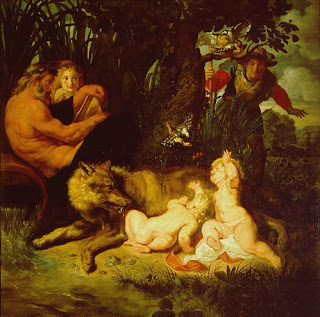
Another fun fact: Professor Lupus from Harry Potter transformed into a werewolf every full moon.
Yet another fun fact: the word Lupus is another form of the word luna means moon- which is what makes werewolves transform.
Wednesday, October 1, 2008
Callisto translation test
Part One
Often poets ask the Muses to tell the story. "Tell, O Muse, the story of the nymph, Callisto and her son, Arcas."
"Look to the stars in the sky," said the Muse. "See the seven stars, Ursa Major, and the other seven stars, Ursa Minor. Ursa Major is Callisto, and Ursa Minor is Arcas, her son. Because of the anger of the queen of the gods, Jupiter transformed the nymph and her son into stars in the sky."
Callisto is a nymph whose form is pretty. She lives in Arcadia. The god Jupiter went to woods and fields in Arcadia, the land of the goddess, he saw the form of the beautiful nymph and loved her instantly. Certainly the form was Callisto. The band that retained her clothes neglected to retain her hair. Callisto was in the woods when Diana and the other nymphs left.
Then Callisto was alone and asleepin the grassland; Jupiter saw her. The nymph was pleasing to the god. "Juno must not see me here," He said, "or if she does see me, I will have an expensive price to pay."Then Jupiter took the form of Diana and the nymph recognized the goddess. Jupiter was the victor; However Callisto, the miserable nymph, in the familiar woods and familiar friends saw that it was not the goddess Diana
Part Two
Juno, the queen of the gods was very angry. The time was appropriate for human punishment.
When the boy Arcas was born to the nymph, Juno said, "No cause is hindered. See my wrong, adulteress!" But Jupiter is away. He will not protect you. I will change your beautiful figure."
She said and held the hair of the nymph and threw her down on the ground. While the miserable Callisto stretched out pleading arms, they arms grew rough, shaggy hair. No words remain in the nymph.; only a hoarse voice. Callisto is now a wild bear, but human sense remained in the bear. A! How often she wandered in fields formerly her own. A! How often had she fled, terrified, men and wild animals, she herself an animal.
Monday, September 29, 2008
Voacb Quiz- Pan et Syringa
1. ager- field
2. bracchium- arm
3. concilium-union
4. fugi fugii- to flee
5. papyrus- papyrus
6. satyrus - satyr
7. Syringa- Syringa (the nymph)
8. vir viri- man
9. divivero- devote
10. fugito fugitaro- fugitive
11. puto putare- to think
12. tenero tenere- to touch
13. benignus- kind
14. densus- dense
15. nullus- no one
16. iternum-
17. autem- however
18. donec
19. eam- her
20. eos- them
bonus
olim- once
quamquam- therefore
Saturday, September 27, 2008
Don't forget to brush your teeth
The ancient Romans used urine as toothpaste. It could be used as a mouthwash in its liquid form. Surprisingly urine is sterile. Romans also had tooth powder, which was skilfully prepared and generally used among them. They were made from abrasive materials such as the bones, hooves, and horns of certain animals, crabs, egg-shells, and the shells of oysters and the murex were the basis of the mixture. They were burnt and then sometimes mixed with honey and ground into a fine powder. The intention of the powder was not only to clean the teeth and make them white, but also to fix them when loose, to strengthen the gums and to relieve tooth aches.
Did Ovid deserve to be exiled?
Annie BattistaLatin IIIOvid did not deserve to be exiled because for expressing his creativity through poetry, even if the poetry was encouraging men to commit adultery. However, that is by today’s standard. It says a lot about a society, and its leaders when they exile one of the most influential and famous poets in their city for writing slightly corruptive poetry. It says that the leader, in this case Augustus, feels the need to have complete control over his citizens. Do they even belong to the leader? Should the possessive term “his” be necessary? In this case, yes.The rulers owned their citizens. Ancient Rome is a culture that the present day world owes a lot to, but no one ever looks further into the lives of the Roman citizens. They were told what to worship and what job to have; how to work and how to live; where to live and where they could go. What Ovid did was stupid. He knew that the Roman officials would not approve of his book. The reason he wrote Ars Amatoria could have been just because he wanted to teach men how to seduce married women or it could have been because he was tired of the traditional poetry that he was expected to produce. Maybe he wanted to shake things up through disregarding what was acceptable and expected and write what he wanted to write. That was reason enough for Augustus to exile him.Not only did they exile Ovid, but they also removed all his works from the libraries. Why did they care so much about Ovid’s books? They were afraid that he would influence men to commit adultery, so they did not give them the chance to decide for themselves what their morals were or what they thought of Ovid’s book.Ovid did not deserve to be punished for writing a book about adultery, however immoral it may be by Roman standards. It is a romantic idea, but people should be to express themselves and experience new ideas for themselves as long as it does not hurt anyone else. When society is burdened by having to hold the beliefs that their ruler does; it is a travesty for the human spirit.
Wednesday, September 24, 2008
Translation Test
Part I
The poet Ovid tells the tale of the goddess Latona and the woman Niobe. Niobe, the queen of Thebes, is arrogant. She is arrogant because she has seven sons and seven daughters. Her children’s friends praise them. “The cause of my arrogance is not the power of my friends and family, but the fame of my children.”
However, the goddess Latona had famous children. Her son is the god Apollo and her daughter is the goddess Diana.
Manto is a wise woman in the town of Thebes. Manto has much wisdom. She walked to into the town and advised the women: “Give gifts to Latona and therefore give gifts to her children, Phoebe and Diana. Latona is the goddess of women.” However the woman of Thebes went to the ornate temple, and gave gifts to the goddess of frankincense and burning incense.
Then Niobe arrogantly went to the women with her children. With proud eyes she turned to them, the women of Thebes and proclaimed: “What does Latona say? No one says me. I am the famous daughter. I am queen of the king Cadmus. Pulchra sum, the dignified goddess. But the greatest of all, I have seven pure sons and seven daughters. Rogate none cause my arrogance. Cur Latona my praestat? Latona only has one son and one daughter. My fortune gave me seven of each. Woman, hear me, not Latona. Give me gifts, not Latona.”
Therefore, the women of Thebes gave the queen arrogance. They didn’t give Latona.
Part II
The goddess Latona was very angry. Her children, Phoebe and Diana told her the long story of the arrogant woman. The mother said to them: “The people are not honoring me in the temple. The people are not of the temple. Oh Phoebe and Diana, free me, iuvate me!”
Then Phoebe said: “Enough!
Monday, September 22, 2008
Blondes Have More Fun
Roman women loved wearing wigs, especially blonde ones. They were made from the hair of Germanic women. The Roman women's husbands would bring back the blonde hair of the dead Germans for their wives' wigs. Black haired wigs from India were also popular. Women also used chalk to make their skin look paler because it was a sign that they were rich enough to not have to work outdoors. They used a mixture of olive oil and soot to make eyeliner. Mirrors were made from glass or polished metals.
Literary Terms Quiz
1. hyperbole- extravagant exaggeration
2. timesis- separation of a compound word
3. ellipsis- the omission of words in a list
4. enjambment- the running over of a sentence, phrase, or clause into the next line
5. strophe- stanza
6. personification- giving inanimate objects the characteristics or qualities of humans
7. irony- the meaning of a phrase or sentence meaning the opposite or something different than what was explicitly stated
8. hiatus- lack of elision
9. caesura- a break in a clause or sentence
10. alliteration- the repetition of a sound, usually the first initial or word
Friday, September 19, 2008
The Misunderstood History of the Caesar Salad
For years I thought the Caesar salad was named for the ancient Roman ruler, Julius Caesar. Well, today i found that I was wrong. In fact, the Caesar salad is named for its creator, Caesar Cardini. According to his daughter, Rosa, the salad was created on July 4th 1924. It was a busy weekend at Caesar's restaurant and he was running low on supplies. He didn't want to dissapoint customers by not serving salad so he created the salad with what was available to him. The salad soon became a hit. I believe that the reason for my misconception is because of Newman's Own Caesar Salad Dressing bottles. They mistakenly placed a photo of Paul Newman portrayed as Caesar on the bottle.


Subscribe to:
Posts (Atom)